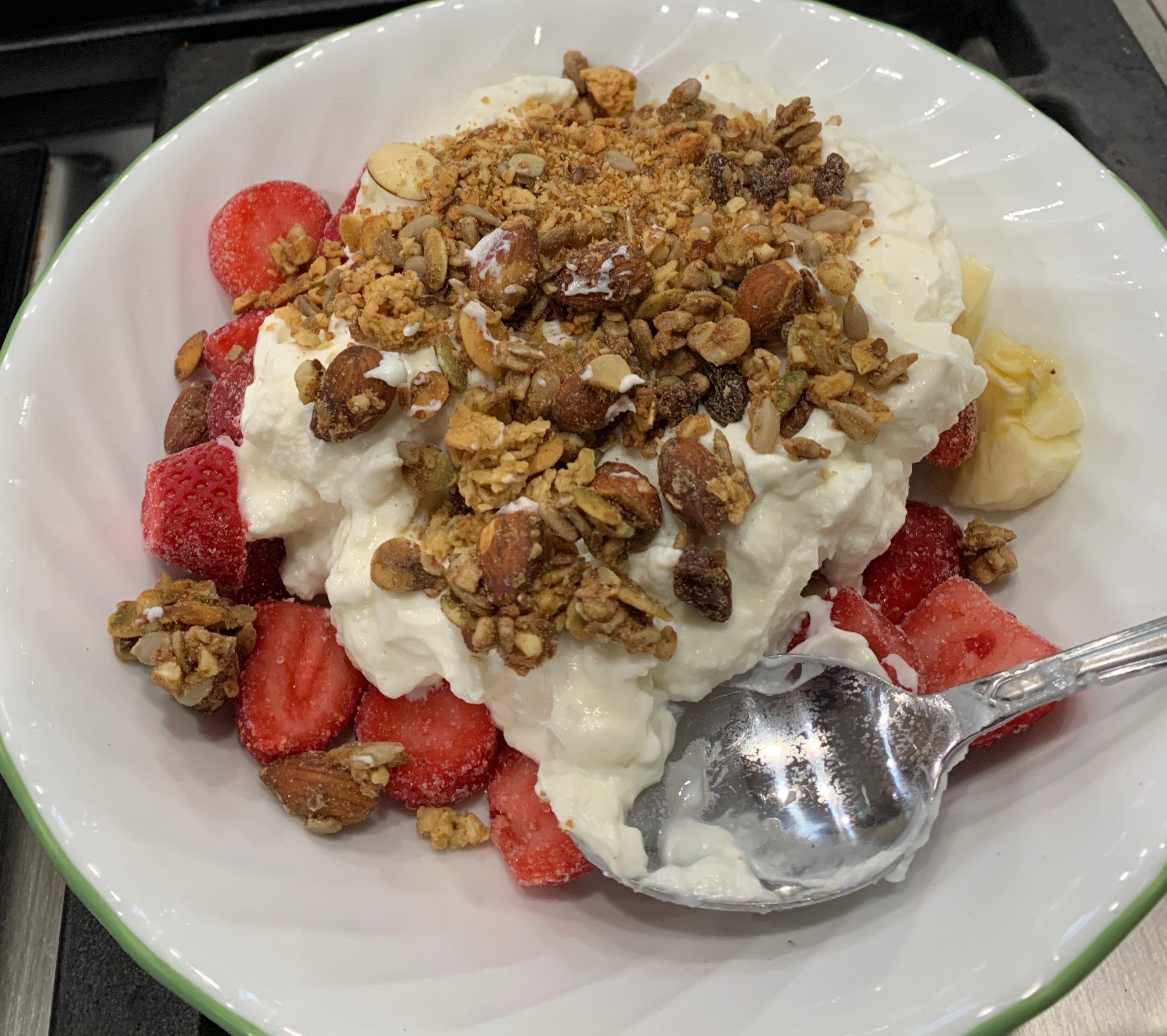
Thicker than anything you can buy at the store–because we strain it longer. One gallon of milk, a spoonful of starter, and overnight patience.
The Story
I developed this recipe because I was tired of buying yogurt. Not tired of eating it–tired of the plastic. Every week, another stack of single-use containers going into the recycling bin (or more honestly, into the trash when the lids and film tops don’t qualify). Multiply that across a year, and it’s a staggering amount of packaging for something that’s essentially just milk and cultures.
So I figured it out myself. No family recipe to fall back on, no cookbook to follow–just research, experimentation, and a lot of thermometer checks. The stovetop and oven method I landed on is surprisingly simple. You heat milk, cool it, stir in starter culture, and let your oven do the rest overnight. By morning, you have yogurt. Strain it through jelly bags, and you have thick, tangy Greek yogurt that rivals anything you’d find at the store.
Here’s the part that really hooked me: once you make your first batch, you never need to buy starter again. You reserve 3/4 to 1 cup from each batch to start the next one. It’s self-perpetuating. One gallon of whole milk becomes approximately two quarts of thick Greek yogurt, and the cycle just keeps going. The cultures stay alive batch after batch, as long as you treat them right.
The simplicity is what makes this sustainable in both senses of the word–it’s good for the environment, and it’s easy enough to actually keep doing week after week. No special equipment beyond a thermometer and some mason jars. No complicated techniques. Just patience and a little bit of planning.
Key Details
Prep Time: 30 minutes | Cook Time: 10 minutes | Fermentation Time: 8-12 hours (overnight) | Straining Time: 1-4 hours | Yield: Approximately 2 quarts thick Greek yogurt
Sustainability Note: Every batch of homemade yogurt eliminates 4-6 single-use plastic containers from the waste stream. Use your previous batch as starter culture, and you’re creating a self-perpetuating cycle that requires nothing but milk and time. Vacuum-sealed mason jars replace disposable packaging entirely.
The Recipe
Ingredients
| Amount | Ingredient |
|---|---|
| 1 gallon | Whole milk |
| 3/4 - 1 cup | Plain yogurt (from previous batch or store-bought starter) |
Starter Note: Use yogurt from your previous batch whenever possible. If starting fresh, Fage plain Greek yogurt works well as a starter.
Equipment
- Large heavy-bottomed pot
- Instant-read thermometer
- Jelly bags for straining
- Quart-sized mason jars with plastic reusable lids and gaskets
- Vacuum sealer for jar lids
Instructions
-
Heat the milk:
- Pour gallon of whole milk into a large heavy-bottomed pot.
- Heat over medium heat, stirring occasionally to prevent scorching.
- Heat until milk reaches 180 degrees F.
-
Cool the milk:
- Remove pot from heat.
- Let milk cool to 110-115 degrees F.
- This can take 30-60 minutes depending on room temperature.
- Stir occasionally and check temperature.
-
Temper the starter:
- Place 3/4 to 1 cup of plain yogurt in a small bowl.
- Ladle about 1 cup of the warm milk into the yogurt.
- Whisk gently until smooth and combined.
- This prevents shocking the cultures with too much heat.
-
Combine:
- Pour the tempered yogurt mixture back into the pot of warm milk.
- Stir gently to distribute the cultures evenly.
-
Incubate overnight:
- Cover the pot with a lid.
- Place in oven with the oven light on (or oven set to lowest temperature, then turned off).
- The oven light provides just enough gentle warmth to keep the cultures active.
- Let sit overnight, 8-12 hours.
- Do not disturb during incubation.
-
Check the yogurt:
- Yogurt should be set and slightly jiggly.
- It will thicken more after straining and chilling.
-
Strain for Greek-style thickness:
- Line a colander with jelly bags over a large bowl.
- Pour yogurt into the jelly bags.
- Let strain until whey is only dripping–at least 1 hour.
- For thicker yogurt, strain 3-4 hours.
- We strain ours 3-4 hours minimum. The result is noticeably thicker than store-bought Greek yogurt, which is often thickened with additives rather than proper straining. Ours holds its shape on a spoon.
-
Store:
- Transfer strained yogurt to quart-sized mason jars.
- Use plastic reusable lids with gaskets.
- Vacuum seal the lids for extended freshness.
- Reserve 3/4 to 1 cup as starter for your next batch before sealing.
Why This Recipe
Yogurt is one of the worst plastic offenders in your fridge. Think about how many yogurt containers your household goes through in a month. Each one is a single-use plastic cup with a foil lid, a plastic over-lid, and sometimes a shrink-wrap band. Most of those components are not recyclable in standard curbside programs. When you make yogurt at home and store it in reusable mason jars, you eliminate all of that packaging–permanently.
The cost savings are real. A gallon of whole milk costs approximately $4-5 and produces about two quarts of thick Greek yogurt. Compare that to store-bought Greek yogurt at $5-7 per quart, and you’re cutting your yogurt budget roughly in half. The starter costs nothing once you’re using your own previous batch. Over a year of weekly batches, that adds up to meaningful savings.
You control what goes into it. Store-bought yogurt often contains added sugars, thickeners, stabilizers, and preservatives. Homemade Greek yogurt contains exactly two ingredients: milk and cultures. That’s it. You decide what sweeteners or flavors to add when you serve it, and you know exactly what you’re eating.
Notes & Variations
- Milk choice: Whole milk produces the thickest, creamiest yogurt. You can use 2% milk, but the result will be thinner and less rich.
- Straining time: The longer you strain, the thicker the yogurt. One hour gives you a standard Greek-style consistency. Three to four hours yields something noticeably thicker than anything you can buy–closer to labneh. This is how we make it. Commercial Greek yogurt is often thickened with corn starch or guar gum instead of proper straining; when you strain long enough, you don’t need any of that.
- Whey: Don’t pour the strained whey down the drain. Save it for smoothies, use it in place of water when cooking rice, or add it to baking recipes that call for buttermilk.
- Temperature matters: The two critical temperatures are 180 degrees F (heating) and 110-115 degrees F (cooling before adding starter). An instant-read thermometer is essential–don’t guess.
Gluten-Free Notes:
- This recipe is naturally gluten-free. Yogurt contains no flour, grains, or gluten-containing ingredients.
- Always verify that your store-bought starter yogurt does not contain gluten-based additives (most plain yogurts do not, but check the label).
Additional notes from our kitchen:
- Vacuum sealing: Vacuum sealing the mason jar lids is the key to longevity. Without it, homemade yogurt keeps 1-2 weeks. With vacuum sealing, you’ll get 2-3 weeks of freshness easily. We use a handheld vacuum sealer designed for mason jar lids–it takes about 10 seconds per jar.
- Self-perpetuating starter: Always reserve 3/4 to 1 cup of finished yogurt before you eat into the batch. I set mine aside in a small jar right after straining so I don’t forget. This is your starter for next time. As long as you keep the cycle going, you’ll never need to buy starter yogurt again.
- Oven method details: The oven light in most conventional ovens generates just enough heat (around 100-110 degrees F) to keep the cultures active without cooking them. If your oven light doesn’t generate warmth, try setting the oven to its lowest temperature for 2-3 minutes, then turning it off before placing the pot inside.
- Batch timing: I make yogurt on the same day each week. Heat the milk in the evening, let it incubate overnight, strain in the morning. It becomes routine quickly.
Serving Suggestions
- Top with fresh or frozen berries and a quarter cup of granola
- Drizzle with honey or maple syrup
- Blend into smoothies for a thick, creamy base
- Use as a substitute for sour cream in recipes
- Serve alongside Fluffy Apple Oatmeal for a complete breakfast
- Use as a base for overnight oats
- Mix with herbs and garlic for a quick dip or sauce
Storage & Make-Ahead
- Refrigerate: Store in vacuum-sealed mason jars for 2-3 weeks. Without vacuum sealing, use within 1-2 weeks.
- Starter Prep: Reserve 3/4 to 1 cup from each batch as starter for your next batch. Store in a separate small jar in the refrigerator.
- Whey Storage: Strained whey keeps in the refrigerator for up to 2 weeks. Freeze in ice cube trays for longer storage.
- Weekly Rhythm: Make a batch every 7-10 days to maintain a steady supply and keep your starter culture active and healthy.
Links & References
- Source: Jean Seely original recipe
- Related Recipes:
- Grandma Seely’s Banana Muffins–use yogurt as a topping or mix-in
- Homemade Bone Broth–another from-scratch staple that eliminates packaging
- Fluffy Apple Oatmeal–pair with a dollop of yogurt for breakfast
- Mom’s Thai Curry–yogurt works as a cooling side
- The Jeanius Cheesecake–for when you want to use strained whey in baking
- Useful Resource: National Center for Home Food Preservation–food safety guidelines
Equipment used in this recipe: As an Amazon Associate, I earn from qualifying purchases.
- Ball Regular Mouth Mason Jars — ideal for storing and fermenting yogurt
- 3-in-1 Electric Mason Jar Vacuum Sealer Kit — extends shelf life after opening
- Stainless Steel Jelly Strainer Stand with Bags — for straining into thick Greek-style yogurt
Print This Recipe
Click here to print this recipe or use your browser’s print function (Cmd+P on Mac, Ctrl+P on Windows).
Homemade Greek Yogurt Prep: 30 min | Cook: 10 min | Fermentation: 8-12 hours | Straining: 1-4 hours | Yield: ~2 quarts
Ingredients:
- 1 gallon whole milk
- 3/4 - 1 cup plain yogurt (previous batch or store-bought starter like Fage)
Equipment:
- Large heavy-bottomed pot, instant-read thermometer, jelly bags, mason jars with reusable lids, vacuum sealer
Instructions:
- Heat milk to 180 degrees F in heavy-bottomed pot, stirring occasionally
- Cool to 110-115 degrees F (30-60 minutes)
- Temper starter: whisk 1 cup warm milk into yogurt in a small bowl
- Stir tempered starter back into pot of warm milk
- Cover pot, place in oven with light on, incubate 8-12 hours overnight
- Strain through jelly bags over a bowl–1 hour for standard, 3-4 hours for extra thick
- Transfer to mason jars, vacuum seal lids
- Reserve 3/4 - 1 cup as starter for next batch
Storage: Vacuum-sealed mason jars, 2-3 weeks refrigerated. Without vacuum seal, 1-2 weeks.
One gallon of milk, a spoonful of starter, and a little patience–that’s all it takes to stop buying plastic and start making something better. Reducing single-use waste, one jar at a time.