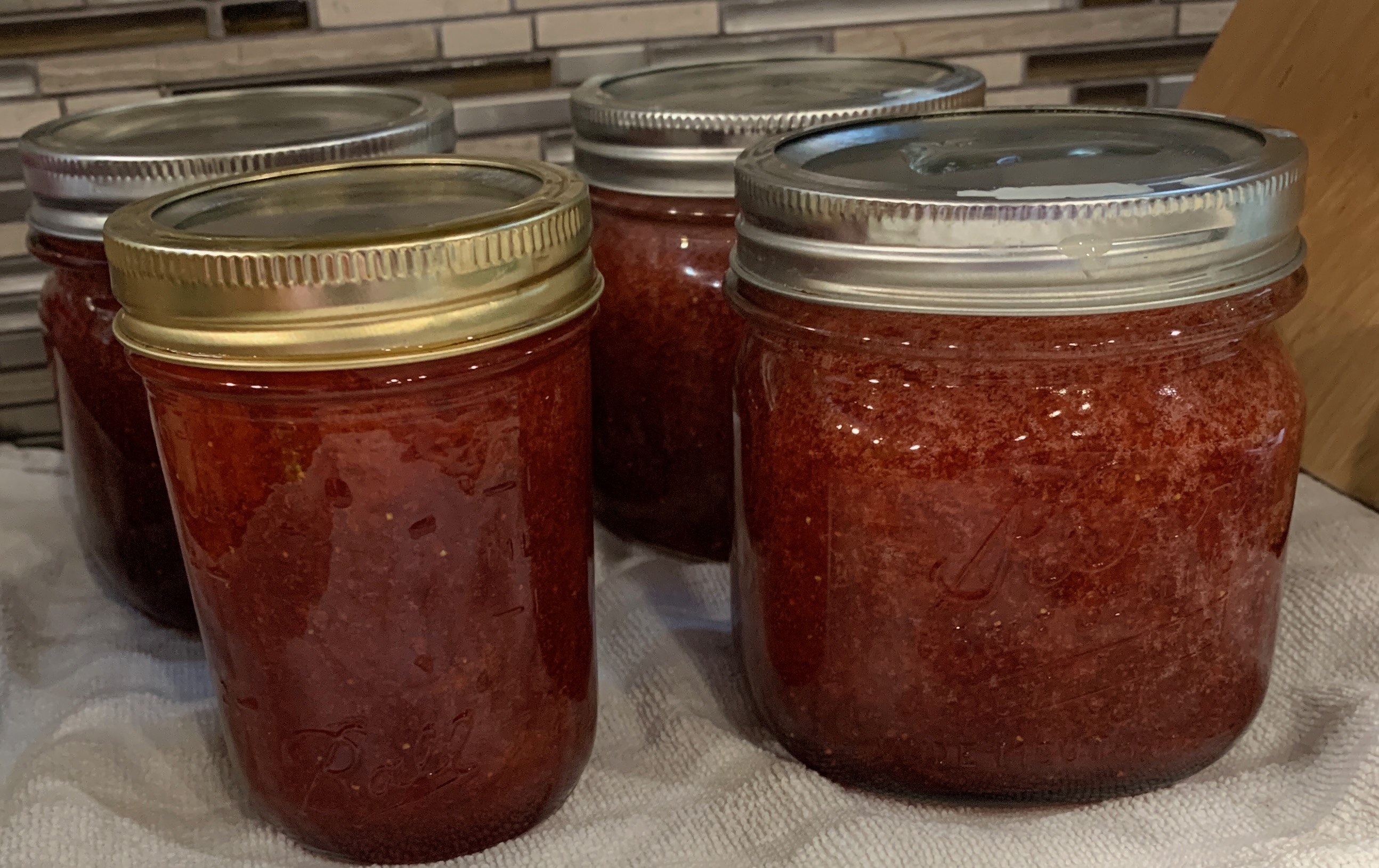
The first thing I ever canned–and the reason my family hasn’t bought store jam since.
The Story
Everyone has a first. Mine was strawberry jam.
I’d been curious about canning for a while–the idea of preserving food at home, building a pantry of things I’d made myself, felt like exactly the kind of skill I wanted to learn. But canning can be intimidating. There are jars and lids and processing times and safety rules, and it’s easy to talk yourself out of trying. I finally decided to just go for it, and strawberry jam was my gateway.
I’m glad I started here. Jam is one of the most forgiving things you can can. The process is straightforward: prepare fruit, add pectin and sugar, bring it to a rolling boil, fill your jars, and process them in a water bath. That’s it. The whole thing takes under an hour, and at the end you have eight beautiful half-pint jars of jam sitting on your counter, lids popping as they seal. That sound–the pop of a lid sealing–is addictive. I was hooked immediately.
I do one thing differently from the traditional method. Instead of crushing the strawberries by hand, I send them through a blender. This turns them into juice with seeds rather than chunky crushed fruit, and I love the smooth texture it gives the finished jam. It spreads beautifully and has a consistent berry flavor in every bite. Some folks prefer chunky jam, and that’s fine–you can absolutely crush them the old-fashioned way. But the blender method is faster, easier, and gives results my family prefers.
And speaking of my family: ever since that first batch, we’ve barely bought jam from the store. The only time we pick up a jar is when we’re traveling or–rarely–when my stock runs out. Homemade strawberry jam tastes like actual strawberries. It’s vibrant and fresh and sweet in a way that store-bought jam, with its long ingredient lists and shelf-stable additives, simply cannot match. Once you’ve had the real thing, going back feels like a downgrade.
That first batch of strawberry jam opened a door. It led to raspberry jam, salsa, pickles, bone broth, and an entire approach to food preservation that’s now central to how we eat. If you’ve been thinking about trying canning, this is where I’d tell you to start.
Key Details
Prep Time: 30 minutes | Cook Time: 15 minutes | Processing Time: 10 minutes | Total Time: 55 minutes | Yield: About 8 half-pint jars
Sustainability Note: Homemade jam means no plastic packaging, no preservatives, and no mystery ingredients–just fruit, sugar, and pectin. Buy strawberries at peak season (often the cheapest price of the year), preserve them, and enjoy homemade jam for months. Eight jars of jam for the cost of a couple quarts of berries beats the $4-6 per jar you’d pay at the store.
The Recipe
IMPORTANT CANNING SAFETY NOTE: This recipe uses the water bath canning method, which is safe for high-acid foods like fruit jams. Always follow current USDA guidelines for home canning. Use tested recipes with proper pectin ratios–do not reduce sugar, as it affects the set and the preservation. Ensure jars seal properly, and refrigerate any jars that do not seal. When in doubt, consult the National Center for Home Food Preservation for current guidelines.
Equipment Needed
- Boiling-water canner
- 8 half-pint canning jars with lids and bands
- Large 6-8 quart saucepot
- Jar lifter
- Ladle
- Metal spoon
Ingredients
| Amount | Ingredient |
|---|---|
| 5 cups | Prepared fruit (buy about 2 qt. fully ripe strawberries) |
| 1 box (1.75 oz) | SURE-JELL Fruit Pectin |
| 1/2 tsp | Butter or margarine |
| 7 cups | Granulated sugar (measured into a separate bowl) |
Instructions
-
Prepare jars and lids:
- Bring boiling-water canner, half full with water, to simmer
- Wash jars and screw bands in hot soapy water
- Rinse with warm water
- Pour boiling water over flat lids in saucepan off the heat
- Let lids stand in hot water until ready to use
- Drain jars well before filling
-
Prepare fruit:
- Stem strawberries
- Traditional method: Crush strawberries thoroughly, one layer at a time
- Jean’s method: Send through blender to make juice with seeds (this is what I do–smoother texture, faster prep)
- Measure exactly 5 cups prepared fruit into 6- or 8-qt. saucepot
-
Cook jam:
- Stir pectin into fruit in saucepot
- Add 1/2 tsp butter to reduce foaming
- Bring mixture to full rolling boil on high heat, stirring constantly
- (A rolling boil is a boil that does not stop bubbling when stirred)
- Stir in 7 cups sugar all at once
- Return to full rolling boil
- Boil exactly 1 minute, stirring constantly
- Remove from heat
- Skim off any foam with metal spoon
-
Fill jars:
- Ladle immediately into prepared jars
- Fill to within 1/4 inch of tops (this is your headspace–it matters)
- Wipe jar rims and threads clean
- Cover with two-piece lids
- Screw bands tightly
-
Process:
- Place jars on elevated rack in canner
- Lower rack into canner
- Water must cover jars by 1 to 2 inches (add boiling water if needed)
- Cover canner
- Bring water to gentle boil
- Process 10 minutes
- Remove jars and place upright on towel to cool completely
- Do not disturb jars while cooling–let them sit for 12-24 hours
-
Check seals:
- After jars cool completely, check seals
- Press middle of lid with finger
- If lid springs back, it is not sealed–refrigerate that jar and use within 3 weeks
- Properly sealed lids will not move when pressed
Why This Recipe
Canning is the gateway skill to food preservation. If you’ve been curious about preserving your own food but haven’t taken the first step, strawberry jam is where to start. It’s a simple water bath recipe with a short processing time, inexpensive ingredients, and a forgiving process. You don’t need years of experience or a commercial kitchen–you need a big pot, some jars, and about an hour.
Homemade jam tastes better and costs less. A jar of quality strawberry jam runs $4-6 at the store, and the ingredient list often includes high-fructose corn syrup, artificial flavors, and preservatives. This recipe uses four ingredients–strawberries, pectin, butter, and sugar–and produces approximately eight jars. Buy strawberries at peak season, when they’re cheapest and most flavorful, and you’re making jam for roughly a dollar a jar. That’s a fraction of store price for a product that tastes dramatically better.
Food preservation is sustainability in action. When you learn to preserve food at home, you’re reducing packaging waste, eliminating food miles for that product, and building a pantry that doesn’t depend on the grocery store supply chain. Every jar of homemade jam on my shelf is one fewer jar with a plastic-lined lid and a label that traveled across the country. It’s one of the most tangible ways to close the loop between your kitchen and your values. That first batch of strawberry jam was the beginning of a practice that now includes bone broth, salsa, pickles, and dozens of other preserved foods throughout the year.
Notes & Variations
- Exact measurements matter: Use exactly 5 cups of prepared fruit and exactly 7 cups of sugar. With canning, precision ensures proper set and safe preservation.
- Rolling boil: This means a boil that does not stop bubbling when stirred. If it calms down when you stir, it’s not there yet.
- Timing is critical: Boil for exactly 1 minute after adding sugar. Too short and the jam won’t set; too long and it gets thick.
- Blender vs. crushing: My blender method gives a smoother, more spreadable jam. For chunkier texture, crush berries by hand, one layer at a time.
- Seedless option: Press crushed berries through a fine mesh strainer to remove seeds before measuring.
- Mixed berry variation: Try 3 cups strawberries and 2 cups raspberries for a mixed berry jam.
Gluten-Free Notes:
- This recipe is naturally gluten-free–no modifications needed. Fruit, sugar, and pectin contain no gluten. Just verify your pectin brand (SURE-JELL is GF) and you’re good to go.
Additional notes from our kitchen:
- Peak season buying: Strawberries are cheapest and best-tasting in June and July in Wisconsin. That’s when I do my big jam batches. Watch for sales at farmer’s markets and local farms.
- Prep efficiency: I wash and stem all the berries first, then send them through the blender in batches. Have everything measured and ready before you start cooking–once the boil starts, timing is critical.
- First-timer tip: Do a practice run with one batch before attempting a double. Get comfortable with the process, the timing, and the jar handling. Confidence comes with the first successful batch.
- Foam is normal: The butter helps reduce it, but you’ll likely still have some. Just skim it off with a metal spoon after removing from heat. Some folks save the foam to spread on toast–it tastes great, it just doesn’t look as clean in the jar.
- Do not double the batch: SURE-JELL specifically does not allow doubling — the pectin chemistry doesn’t scale and your jam won’t set. If you want more jam, make multiple single batches back to back. This applies to most commercial pectins; always check your pectin’s package instructions before scaling.
Serving Suggestions
- On warm toast or fresh bread with butter
- Classic PB&J sandwiches–homemade jam elevates them completely
- Swirled into plain yogurt for a quick breakfast
- Spread on warm biscuits or scones
- Layered into banana muffins batter for a fruity twist
- Gift jars to friends and neighbors–homemade jam makes an excellent hostess gift
Storage & Make-Ahead
- Sealed jars: Store in a cool, dark place for up to 1 year. A pantry shelf or basement works well.
- Opened jars: Refrigerate after opening and use within 3 weeks.
- Failed seals: Refrigerate immediately and use within 3 weeks. (Check every jar–if the lid springs back when pressed, it did not seal.)
- Berry prep: You can wash and stem strawberries the day before and refrigerate them. Blend and measure when you’re ready to cook.
- Gifting: Half-pint jars are the perfect gift size. Add a label with the date and contents.
Links & References
Equipment
Equipment used in this recipe: As an Amazon Associate, I earn from qualifying purchases.
- Prep N Cook 21.5-Qt Water Bath Canner — induction compatible, stainless steel
- Ball Canning Utensil Set — jar lifter, funnel, ladle, and tongs
- Ball Regular Mouth Mason Jars — half-pint size works great for jam
- Stainless Steel Jelly Strainer Stand with Bags — for clear, seedless jam
Related Friday Food Posts:
- Grandma Seely’s Banana Muffins - Another from-scratch staple that saves money and reduces waste
- Homemade Bone Broth - Another preservation skill that builds your pantry from scratch
- Mom’s Thai Curry - Homemade beats takeout in flavor, cost, and packaging waste
Canning Resources:
- National Center for Home Food Preservation - The gold standard for canning safety guidelines
- SURE-JELL Recipes - Additional tested pectin recipes
- Source: SURE-JELL Fruit Pectin package recipe, adapted with Jean’s blender method
Print This Recipe
Click here to print this recipe or use your browser’s print function (Cmd+P on Mac, Ctrl+P on Windows).
Homemade Strawberry Jam Prep: 30 min | Cook: 15 min | Process: 10 min | Yield: About 8 half-pint jars
Equipment:
- Boiling-water canner, 8 half-pint jars with lids/bands, large saucepot, jar lifter, ladle, metal spoon
Ingredients:
- 5 cups prepared strawberries (about 2 qt. fresh)
- 1 box (1.75 oz) SURE-JELL Fruit Pectin
- 1/2 tsp butter or margarine
- 7 cups granulated sugar
Instructions:
- Bring canner (half full) to simmer; wash jars and bands; pour boiling water over lids
- Stem berries; blend (or crush) to make 5 cups prepared fruit
- Stir pectin into fruit in saucepot; add butter
- Bring to full rolling boil on high, stirring constantly
- Add all sugar at once; return to rolling boil
- Boil exactly 1 minute, stirring constantly; remove from heat; skim foam
- Ladle into jars leaving 1/4 inch headspace; wipe rims; apply lids and bands
- Process in boiling water bath 10 minutes (water must cover jars by 1-2 inches)
- Remove; cool completely; check seals (lids should not flex)
Storage: Sealed jars up to 1 year in cool, dark place. Refrigerate after opening–use within 3 weeks.
Strawberry jam was the first thing I ever canned. It taught me that preserving food at home isn’t as hard as it seems–it just takes the willingness to try. That first batch gave me confidence, and confidence led to a pantry full of homemade food that my family loves. Start with one batch. The rest will follow.