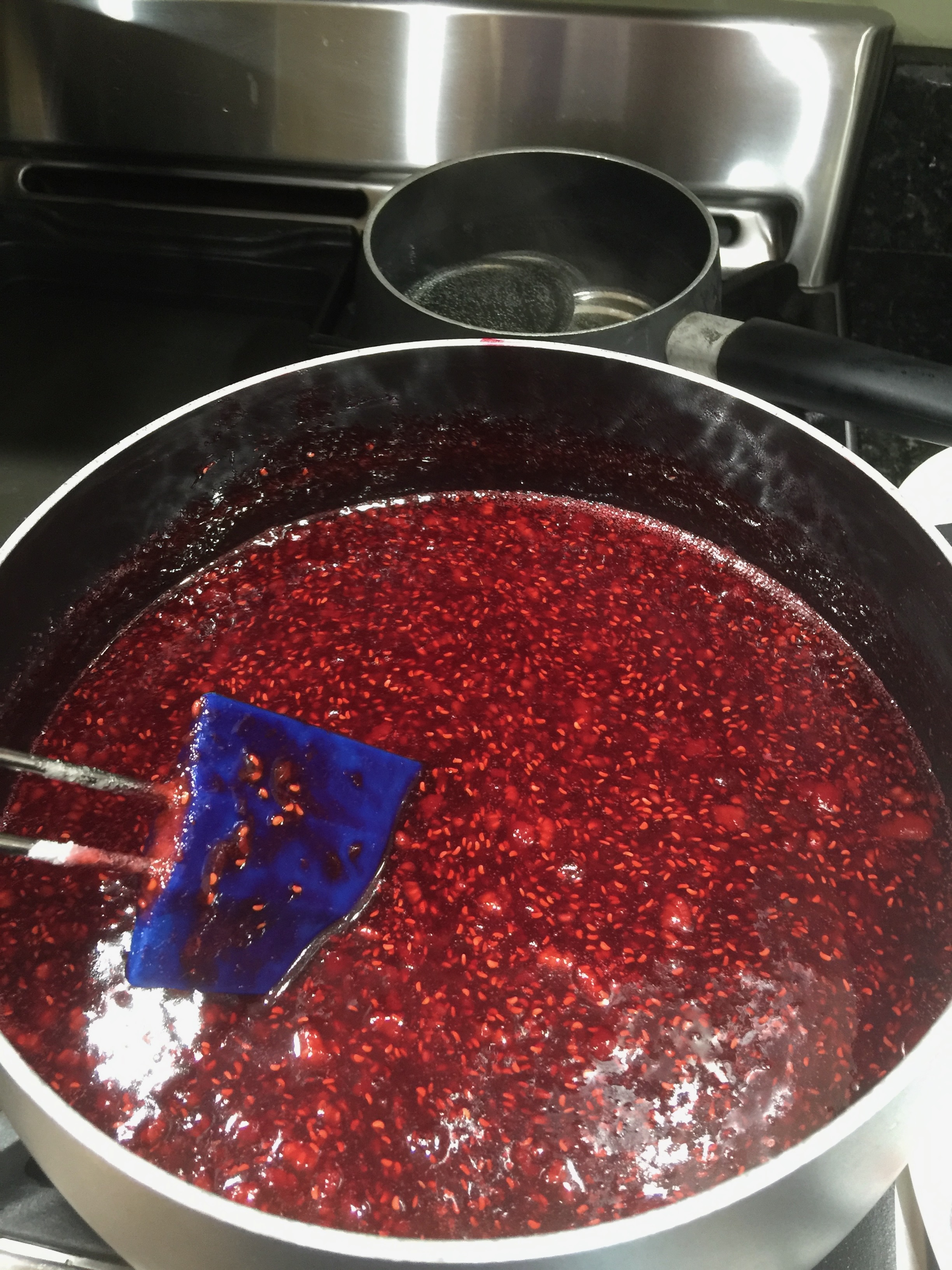
Capture peak raspberry season in a jar—eight half-pints of summer sunshine that will outlast the snow.
The Story
There’s a window in summer when raspberries are perfect. It’s not long—maybe two or three weeks when local berries are at their peak, bursting with flavor and practically falling off the bush. That’s when I make jam.
If you’ve been following along, you know I’ve been building a jam pantry. Strawberry jam came first, and raspberry jam is the natural next step. Same SURE-JELL method, same water bath canning process, same satisfying pop of lids sealing as the jars cool on the counter. Once you’ve made one batch of jam, the second feels like visiting an old friend—you know the steps, you trust the process, and you can focus on enjoying it.
The big decision with raspberry jam is seeds. Some people love them—the tiny crunch is part of the raspberry experience. Others prefer a smooth, seedless spread. The beauty of this recipe is you can go either way. I’ll walk you through both options so you can choose what works for your family. Personally, I go fully seeded. The seeds are part of the raspberry experience, and I’d rather have jam that tastes exactly like the fruit it came from than a smooth spread that could have come from a factory.
And here’s the sustainability angle: when you make your own jam, you’re preserving local, seasonal fruit at its absolute peak. No plastic tubs, no cross-country shipping, no mystery ingredients. Just raspberries, sugar, pectin, and a little time. Eight jars of homemade raspberry jam will carry you from July clear through to next spring—and every time you open one, it tastes like summer.
Key Details
Prep Time: 30 minutes | Cook Time: 15 minutes | Processing Time: 10 minutes | Yield: About 8 half-pint jars
Sustainability Note: Preserving seasonal raspberries at peak ripeness means fewer store-bought jars with their single-use packaging, fewer food miles, and better flavor. A flat of local raspberries turned into eight jars of jam costs a fraction of artisan jam—and you know exactly what’s in it.
The Recipe
Canning Safety Note: This recipe uses tested water bath canning procedures. Follow all measurements, processing times, and headspace requirements exactly as written. Canning is safe and straightforward when you follow the rules—do not improvise on the science. If you’re new to canning, the USDA Complete Guide to Home Canning and the National Center for Home Food Preservation are excellent free resources.
Equipment Needed
- Boiling-water canner with rack
- 8 half-pint canning jars with new lids and screw bands
- Large 6-8 quart saucepot
- Jar lifter
- Ladle
- Wide-mouth canning funnel (optional but helpful)
- Metal spoon
- Fine mesh strainer or cheesecloth (optional, for seedless jam)
Ingredients
| Amount | Ingredient |
|---|---|
| 5 cups | Prepared fruit (about 4 pints fully ripe red raspberries) |
| 1 box (1.75 oz) | SURE-JELL Fruit Pectin |
| 1/2 tsp | Butter or margarine |
| 7 cups | Granulated sugar (measured into a separate bowl before you start) |
Instructions
Prepare Jars and Lids:
-
Fill your boiling-water canner half full with water and bring to a simmer.
-
Wash jars and screw bands in hot soapy water; rinse with warm water. Drain jars well before filling.
-
Heat lids: Pour boiling water over flat lids in a saucepan off the heat. Let stand in hot water until ready to use.
Prepare Fruit:
-
Crush raspberries thoroughly, one layer at a time. You want them well broken down, not just lightly mashed.
- For seedless or reduced-seed jam: Press half (or all) of the crushed pulp through a fine mesh strainer or cheesecloth to remove seeds. Note that straining all the pulp will reduce your yield.
-
Measure exactly 5 cups of prepared fruit into your 6- or 8-quart saucepot. Exact measurement matters for proper set.
Cook the Jam:
-
Stir pectin into the fruit. Add 1/2 tsp butter to reduce foaming.
-
Bring to a full rolling boil on high heat, stirring constantly. A rolling boil is one that does not stop bubbling when you stir it.
-
Add all 7 cups of sugar at once. Stir to combine.
-
Return to a full rolling boil and boil for exactly 1 minute, stirring constantly. Timing matters here—set a timer.
-
Remove from heat. Skim off any foam with a metal spoon.
Fill and Process Jars:
-
Ladle jam quickly into prepared jars, leaving 1/4 inch headspace. A canning funnel makes this much easier and cleaner.
-
Wipe jar rims and threads with a clean, damp cloth. Any jam residue on the rim can prevent a proper seal.
-
Center lids on jars and screw bands on firmly (fingertip-tight—do not overtighten).
-
Place jars on the elevated rack in your canner and lower the rack into the water. Water must cover jars by 1 to 2 inches. Add boiling water if needed.
-
Cover the canner and bring water to a gentle, steady boil. Process for 10 minutes.
-
Remove jars with a jar lifter and place upright on a towel. Do not tilt jars. Let cool completely—do not disturb for 12 to 24 hours.
Check Seals:
- After jars are completely cool, press the middle of each lid with your finger. If the lid does not flex up and down, the jar is sealed. If it springs back, the jar did not seal—refrigerate it and use within 3 weeks.
Why This Recipe
Seasonal eating at its best. Raspberries have a short, glorious season. Making jam is how you hold onto that flavor long after the last berry has been picked. Instead of buying bland, mass-produced jam in January, you open a jar that tastes like a July afternoon. That’s not nostalgia—that’s good planning.
The numbers work. A jar of quality artisan raspberry jam runs $8-12 at a farmers’ market or specialty store. A flat of local raspberries (about $15-20) plus sugar and pectin (another $8-10) gives you eight jars of jam that’s better than anything on a shelf. That’s roughly $3-4 per jar for jam that tastes like it should cost three times as much.
Less packaging, more pantry. Every jar of homemade jam is a store-bought jar you did not buy. No plastic shrink wrap, no labels printed overseas, no cardboard boxes. Your mason jars are reusable year after year—you only replace the flat lids. Over time, the jars pay for themselves many times over.
It builds a skill that compounds. Once you’ve made strawberry jam and raspberry jam, you’ve built real canning confidence. Cherry pie filling, salsa, pickles, dilled green beans—they all follow the same fundamental water bath process. Each recipe you add to your rotation is another way to eat seasonally, reduce waste, and stock your pantry with food you made yourself.
Notes & Variations
- Seeded vs. seedless: The recipe works both ways. For reduced seeds, strain half the crushed pulp. For fully seedless, strain it all (expect slightly less yield). For full seeds, skip the straining entirely.
- Mixed berry: Substitute 2 cups of the raspberries with blackberries for a mixed berry jam. Keep the total prepared fruit at exactly 5 cups.
- Raspberry-peach: Use 3 cups prepared raspberries and 2 cups peeled, finely chopped peaches for a beautiful summer combination.
- Exact measurements are critical: Use exactly 5 cups of fruit and exactly 7 cups of sugar. Canning recipes are formulated for food safety and proper gel—this is not the place to reduce sugar or improvise.
- Rolling boil: If you’re not sure whether you’ve reached a full rolling boil, you probably have not. It’s vigorous and continuous, even when you stir.
Gluten-Free Notes:
This recipe is naturally gluten-free. Raspberries, sugar, SURE-JELL pectin, and butter contain no gluten. No modifications needed—enjoy as-is.
Additional notes from our kitchen:
- Buy local and in season. Farmers’ market raspberries or u-pick berries will give you the best flavor. If you grow your own, even better—the cost drops to almost nothing.
- Freezer trick: If you cannot make jam the day you buy berries, freeze them in a single layer on a sheet pan, then transfer to freezer bags. Thaw and crush when you’re ready to jam. Frozen berries work just as well.
- Prep sugar ahead. Measure your 7 cups of sugar into a separate bowl before you start cooking. When you hit that rolling boil, you need to add the sugar all at once—no scrambling for the measuring cup.
- Jar reuse: Mason jars and screw bands are reusable indefinitely. Only the flat lids need to be new each time. I keep a dedicated shelf for my canning jars and rotate through them season after season.
- Label your jars. Write the contents and date on the lid with a permanent marker, or use masking tape labels. You will thank yourself in February when you’re staring at a pantry of unlabeled jars.
Serving Suggestions
- Spread on warm toast, English muffins, or freshly baked banana muffins
- Swirl into plain or homemade Greek yogurt with granola
- Spoon over warm scones or biscuits with butter
- Add to a cheese board—raspberry jam pairs beautifully with brie, goat cheese, or sharp cheddar
- Use as a filling for thumbprint cookies during holiday baking season
- Layer into a Jeanius Cheesecake for a raspberry swirl variation
- Spread between layers of cake or stir into salad dressings for a fruity vinaigrette
Storage & Make-Ahead
- Sealed jars: Store in a cool, dark place (pantry, basement shelf) for up to 1 year. The flavor is best within the first 6-8 months.
- Opened jars: Refrigerate after opening and use within 3 weeks.
- Failed seals: Refrigerate immediately and use within 3 weeks. (This is not a failure—it’s just “first jar to eat.”)
- Berry prep: Freeze fresh raspberries at peak ripeness and make jam later when your schedule allows.
- Batch planning: If you’re making multiple types of jam in a season, space your batches a week or two apart. Canning is more enjoyable when you’re not exhausted from doing it all in one weekend.
Links & References
Equipment
Equipment used in this recipe: As an Amazon Associate, I earn from qualifying purchases.
-
Prep N Cook 21.5-Qt Water Bath Canner — induction compatible, stainless steel
-
Ball Canning Utensil Set — jar lifter, funnel, ladle, and tongs
-
Ball Regular Mouth Mason Jars — half-pint size works great for jam
-
Stainless Steel Jelly Strainer Stand with Bags — for clear, seedless jam
-
Source: Classic SURE-JELL Raspberry Jam recipe
-
Canning safety: USDA Complete Guide to Home Canning and National Center for Home Food Preservation
-
Related recipes: Banana Muffins | Jeanius Cheesecake | Homemade Bone Broth
Print This Recipe
Click here to print this recipe or use your browser’s print function (Cmd+P on Mac, Ctrl+P on Windows).
Homemade Raspberry Jam Prep: 30 min | Cook: 15 min | Process: 10 min | Yield: About 8 half-pint jars
Equipment:
- Boiling-water canner, 8 half-pint jars with lids and bands, large saucepot, jar lifter, ladle
Ingredients:
- 5 cups prepared fruit (about 4 pints fully ripe red raspberries)
- 1 box (1.75 oz) SURE-JELL Fruit Pectin
- 1/2 tsp butter or margarine
- 7 cups granulated sugar (measured into separate bowl)
Instructions:
- Bring canner half full of water to simmer. Wash jars and bands; heat lids in boiled water off heat.
- Crush berries one layer at a time. Optional: strain half through fine mesh for reduced seeds.
- Measure exactly 5 cups fruit into large saucepot.
- Stir in pectin and 1/2 tsp butter. Bring to full rolling boil, stirring constantly.
- Add all 7 cups sugar at once. Return to full rolling boil; boil exactly 1 minute, stirring constantly.
- Remove from heat; skim foam.
- Ladle into jars, leaving 1/4 inch headspace. Wipe rims. Apply lids and bands fingertip-tight.
- Process in boiling-water canner for 10 minutes (water must cover jars by 1-2 inches).
- Remove jars; cool upright on towel 12-24 hours. Check seals.
Storage: Sealed jars up to 1 year in cool, dark place. Opened jars refrigerate, use within 3 weeks.
Summer doesn’t last forever—but a well-stocked jam pantry means you don’t have to let it go. Every jar is a little act of preservation, of choosing seasonal abundance over year-round convenience. That’s sustainability you can spread on toast.