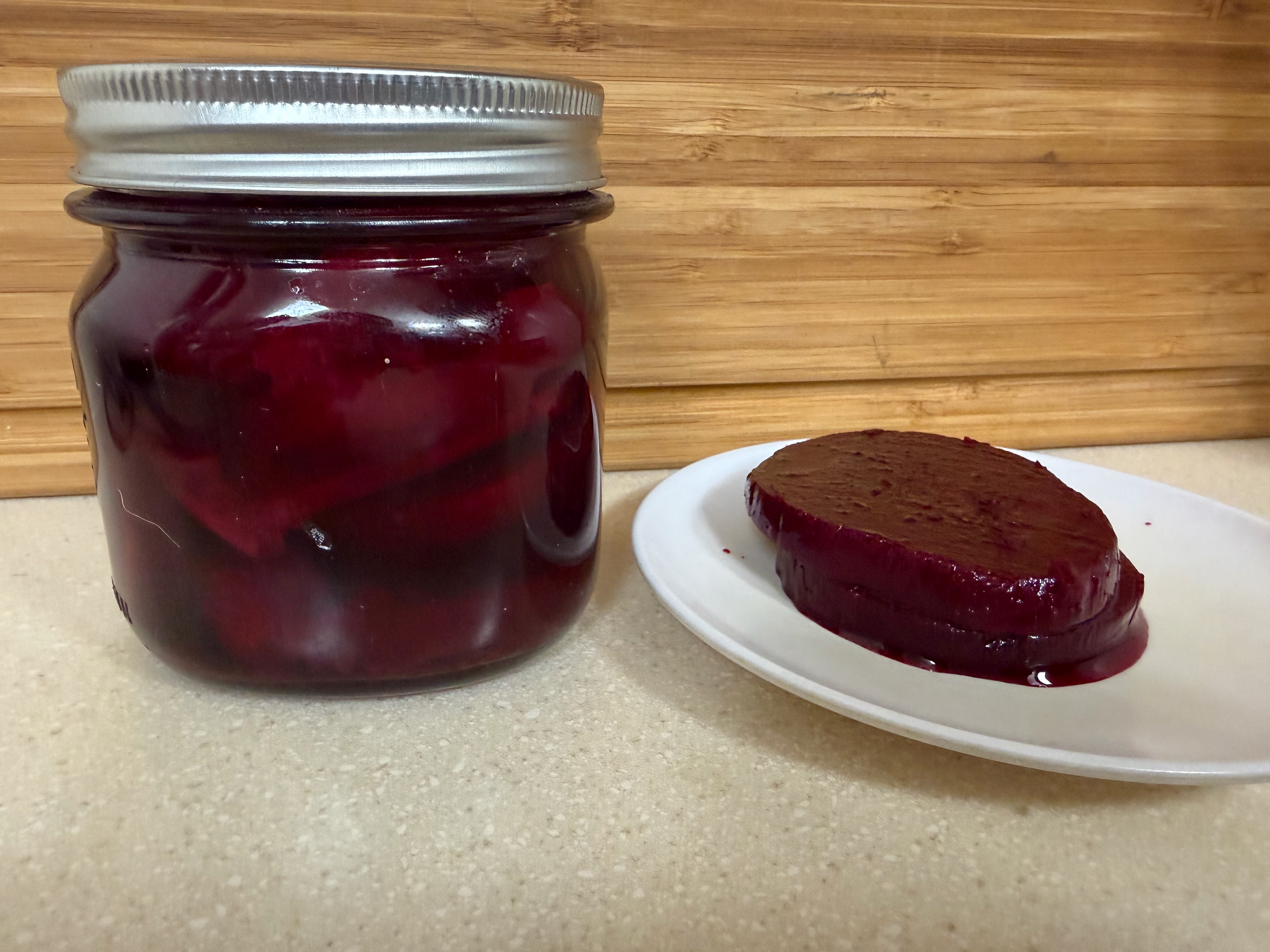
Turn garden beets into sweet, spiced jewels that glow like rubies in the jar–root-to-jar preservation at its most beautiful.
The Story
There’s something about opening a jar of pickled beets in the middle of January that makes you feel like you’ve outsmarted winter. That deep, stunning magenta–it’s summer captured in glass. Grandma Norma’s beet pickle recipe is one of those family treasures that turns a humble root vegetable into something genuinely gorgeous.
I love this recipe for its simplicity. Beets, a sweet and spiced pickling syrup, and a water bath canner–that’s really all you need. The combination of sugar, vinegar, cloves, allspice, and cinnamon creates a syrup that balances sweet, tangy, and warmly spiced in a way that makes pickled beets irresistible. I won’t touch canned beets from a grocery store shelf — but homemade pickled beets are a different thing entirely. The texture is firmer, the flavor is brighter, and the color is absolutely electric.
Grandma Norma knew what every experienced gardener and home preserver knows: root vegetables are the backbone of a sustainable pantry. Beets are one of those crops that thrive in cool weather, store well in the ground, and take beautifully to preservation. When you pickle them, you’re extending the harvest months beyond the growing season–turning a late-summer garden haul into a pantry staple that carries you through winter and into spring.
And here’s the sustainability angle that I find especially satisfying: canning is one of the oldest and most energy-efficient methods of food preservation. Once those jars are sealed, they don’t require electricity to keep. No freezer running, no refrigerator humming. Just a cool, dark shelf and the knowledge that you grew it, preserved it, and can enjoy it whenever you’re ready.
Key Details
Prep Time: 30 minutes | Cook Time: 30 minutes (cooking beets) | Processing Time: 30 minutes | Total Time: ~1 hour 30 minutes | Yield: Varies by amount of beets
Sustainability Note: Root vegetable preservation is one of the most practical sustainability skills you can develop. Beets go from garden to jar with minimal processing, no ongoing energy costs for storage, and a shelf life that extends well beyond a single season with properly sealed jars. Every jar of homemade pickled beets replaces a store-bought can–less packaging, zero preservatives, and a fraction of the food miles.
The Recipe
Equipment Needed
- Large pot for cooking beets
- Saucepan for syrup
- Sterilized canning jars (pints or quarts)
- Canning lids and bands (new lids for each use)
- Boiling-water canner with rack
- Jar lifter
- Wide-mouth funnel (recommended)
- Clean cloths for wiping jar rims
Ingredients
Pickling Syrup:
| Amount | Ingredient |
|---|---|
| 2 cups | Sugar |
| 2 cups | Water |
| 2 cups | Strong vinegar (5% acidity or higher) |
| 1 tsp | Whole cloves |
| 1 tsp | Allspice |
| 2 sticks | Cinnamon |
Beets:
| Amount | Ingredient |
|---|---|
| As needed | Small, young beets (the smaller and younger, the better) |
Instructions
Prepare Beets:
-
Select beets: Choose small, young beets for the best texture and flavor. Uniform size ensures even cooking.
-
Wash thoroughly: Scrub beets well under running water. Leave roots and about 1 inch of stem attached to prevent bleeding during cooking.
-
Cook beets: Place beets in a large pot of boiling water. Cook until tender but still firm–about 25-30 minutes depending on size. Test with a fork or knife; it should slide in easily.
-
Cool and peel: Dip cooked beets into cold water. The skins should slip right off while the beets are still warm. Trim roots and stems. Slice or leave whole if small enough.
Make Pickling Syrup:
-
Combine syrup ingredients: In a saucepan, combine 2 cups sugar, 2 cups water, 2 cups strong vinegar, 1 tsp whole cloves, 1 tsp allspice, and 2 cinnamon sticks.
-
Bring to a boil: Heat over medium-high heat, stirring until sugar dissolves, then bring to a full boil.
-
Remove cinnamon sticks: Take the cinnamon sticks out of the syrup before packing jars.
Can Beets:
-
Prepare jars: Sterilize canning jars in boiling water. Keep jars hot until ready to fill. Prepare lids according to manufacturer directions.
-
Pack jars: Pack cooked, peeled beets into hot sterilized jars.
-
Add hot syrup: Pour hot pickling syrup over beets, leaving 1/4-inch headspace. Use a bubble remover or butter knife to release trapped air bubbles.
-
Seal jars: Wipe jar rims with a clean, damp cloth to remove any residue. Apply lids and screw on bands to fingertip-tight.
-
Process: Place jars in a boiling-water canner. Ensure jars are covered by at least 1-2 inches of water. Process pints and quarts for 30 minutes. Start timing once water returns to a full rolling boil.
-
Cool: Remove jars with a jar lifter and place on a towel or cooling rack. Do not tilt jars. Let cool undisturbed for 12-24 hours.
-
Check seals: After cooling, press the center of each lid. A properly sealed lid will not flex up and down. Any unsealed jars should be refrigerated and used within 2 weeks.
Canning Safety Notes:
- Vinegar acidity: Always use vinegar with at least 5% acidity. Do not reduce the vinegar in this recipe–the acid level is critical for safe water bath canning.
- Headspace: Maintain exactly 1/4-inch headspace for proper sealing.
- Altitude adjustment: If you live above 1,000 feet elevation, increase processing time. Add 5 minutes for 1,001-3,000 feet; 10 minutes for 3,001-6,000 feet.
- Current guidelines: Always verify processing times with current USDA canning guidelines. Safe canning recommendations are updated periodically.
- New lids: Use new canning lids each time. Bands can be reused if in good condition.
Why This Recipe
Garden-to-jar is sustainability you can taste. Growing beets, harvesting them, and preserving them in your own kitchen is one of the most direct paths from seed to table. There’s no processing plant, no packaging facility, no distribution truck. Just your garden, your kitchen, and your pantry shelf. That’s about as low-impact as food gets.
Root vegetables are the unsung heroes of the sustainable garden. Beets are easy to grow, tolerant of cool weather, and productive in small spaces. A single 10-foot row can produce enough beets for several jars of pickles. They’re also one of the first crops you can plant in spring and one of the last you can harvest in fall, extending your growing season on both ends.
Preservation is a skill that compounds. Once you’ve mastered water bath canning with a recipe like this, you’ve unlocked a whole category of food preservation. Pickled beets today, strawberry jam tomorrow, cherry pie filling next week. Every recipe you preserve is food that doesn’t need a freezer, doesn’t require electricity, and doesn’t come wrapped in single-use plastic. Grandma Norma understood that a well-stocked pantry isn’t just convenient–it’s resilient.
Notes & Variations
- Beet size matters: Small, young beets are the key to this recipe. They’re more tender, sweeter, and have a finer texture than large, mature beets. If you can only find larger beets, slice them into uniform pieces after cooking.
- Whole cloves and allspice: These can be left loose in the syrup (they’ll settle) or tied in a cheesecloth bag for easy removal.
- Vinegar strength: “Strong vinegar” means white vinegar with at least 5% acidity–this is standard for most store-bought white vinegar. Check the label.
- Sweetness adjustment: Do not reduce the sugar or vinegar in this recipe. The balance of sugar, acid, and water is what makes this safe for water bath canning.
- Sliced vs. whole: Small beets can be canned whole. Larger beets should be sliced or quartered for even heat penetration during processing.
Gluten-Free Notes:
- This recipe is naturally gluten-free. No modifications needed.
Additional notes from our kitchen:
- Harvest timing: I’ve found that beets picked at 1.5 to 2 inches in diameter are perfect for pickling. They’re tender, sweet, and fit nicely in jars.
- Stain prevention: Beet juice stains everything. Wear an apron, use a cutting board you don’t mind turning pink, and wipe up spills immediately. Lemon juice helps remove stains from hands and counters.
- Batch planning: I usually dedicate a full afternoon to beet pickles–pulling beets from the garden, cooking, making syrup, and canning all in one session. It’s satisfying work, and having the whole process flow from start to finish makes it efficient.
- Reuse the cooking water: The water you boil your beets in will be a beautiful deep red. You can use it to dye eggs, tint homemade pasta, or water your compost pile.
- Let them sit: Pickled beets develop better flavor after 2-4 weeks on the shelf. They’re good immediately, but they’re great after the spices have had time to fully infuse.
Serving Suggestions
- As a side dish alongside roasted meats, pork, or poultry
- Sliced on top of green salads for color, flavor, and crunch
- On a relish tray with olives, pickles, and crackers
- Paired with sharp cheddar or goat cheese on a cheese board
- Alongside homemade bone broth soup for a hearty winter meal
- Diced as a topping for grain bowls
- As part of a holiday dinner spread–the color alone makes any table look festive
Storage & Make-Ahead
- Sealed jars: Store in a cool, dark place. The USDA recommends using home-canned goods within 1 year for best quality — but properly sealed jars can last well beyond that. I’m the only one in my house who eats pickled beets, so I make them every few years rather than every season, and I’ve used jars that are 2-3 years old without issue.
- My personal rule: I put too much effort into canning to throw away a jar that’s still sealed and shows no signs of spoilage. Before opening any older jar, I check that the seal is intact (lid doesn’t flex), and once opened I check that the smell and taste are right. If both pass, I use them. Use your judgment — if anything seems off, don’t eat it.
- After opening: Refrigerate and use within 2 weeks.
- Best flavor: Allow jars to sit for 2-4 weeks after canning before opening. The spices need time to develop.
- Seal check: Before storing, always confirm that lids are properly sealed (center should not flex). Label jars with the date processed.
- Year-round planning: Because sealed jars keep well, you don’t need to make beet pickles every year. Can a good batch when your harvest is strong and it’ll carry you through multiple seasons.
Links & References
Equipment
Equipment used in this recipe: As an Amazon Associate, I earn from qualifying purchases.
-
Prep N Cook 21.5-Qt Water Bath Canner — induction compatible, stainless steel
-
Ball Canning Utensil Set — jar lifter, funnel, ladle, and tongs
-
Ball Regular Mouth Mason Jars — pint size is ideal for beet pickles
-
3-in-1 Electric Mason Jar Vacuum Sealer Kit — great for extending shelf life after opening
-
Source: Grandma Norma’s Beet Pickle Recipe
-
Safe canning recipes: Safe Canning Recipez — my go-to resource for tested canning recipes
-
Safety reference: Always verify processing times with the USDA Complete Guide to Home Canning and the National Center for Home Food Preservation
-
Related: Strawberry Jam | Raspberry Jam | Why We Preserve
Print This Recipe
Click here to print this recipe or use your browser’s print function (Cmd+P on Mac, Ctrl+P on Windows).
Grandma Norma’s Beet Pickles Prep: 30 min | Cook: 30 min | Processing: 30 min | Total: ~1 hr 30 min | Yield: Varies
Pickling Syrup:
- 2 cups sugar
- 2 cups water
- 2 cups strong vinegar (5% acidity)
- 1 tsp whole cloves
- 1 tsp allspice
- 2 sticks cinnamon
Beets:
- Small, young beets (as many as needed)
Instructions:
- Wash and cook small, young beets until tender (~25-30 min). Dip in cold water and peel.
- Combine sugar, water, vinegar, cloves, allspice, and cinnamon sticks in a saucepan. Bring to a boil.
- Remove cinnamon sticks from syrup.
- Pack cooked, peeled beets into hot sterilized jars.
- Pour hot syrup over beets, leaving 1/4-inch headspace. Remove air bubbles.
- Wipe rims, apply lids and bands (fingertip-tight).
- Process pints and quarts in boiling-water canner for 30 minutes.
- Cool undisturbed 12-24 hours. Check seals.
Safety: Use vinegar with 5% acidity minimum. Do not alter vinegar/sugar ratios. Adjust processing time for altitude. Verify times with current USDA guidelines.
Storage: Cool, dark place up to 1 year. Refrigerate after opening; use within 2 weeks.
Grandma Norma’s beet pickles aren’t just about preserving beets–they’re about preserving a way of life. Every jar on the shelf is a connection to the garden, to family tradition, and to the quiet satisfaction of knowing you can feed yourself from what you’ve grown with your own hands.