We split a whole grass-finished steer with our son this year. Here’s exactly what we paid — and how it stacks up against record-high beef prices at the store.
Every few months someone asks me whether buying beef “by the animal” is really worth it, or whether it’s one of those homestead things we tell ourselves is thrifty because we want it to be. So this year, when we split a whole grass-finished steer with our son Phil, I did what I always do: I built a spreadsheet, kept every receipt, and ran the actual numbers against what the same beef would cost at the store.
The timing turned out to be everything. Beef prices hit record highs in 2026 — the U.S. cattle herd is at its lowest level in more than 70 years — and that completely changed the answer. Let me walk you through it.
The Setup
We bought one whole grass-finished steer, raised on pasture and finished on grass — no grain, no feedlot — from my cousin. The animal came in at 710 pounds hanging weight, split down the middle: 354 pounds to our household, 356 to Phil’s. Phil lives alone and wanted his steaks packaged as singles, so we ran it as two separate invoices with the butcher — which turned out to be the right call for a different reason too: it made it easy to grab the right boxes off the shelf when delivering beef to two different houses.
Phil is our son, not a business partner, and we’re not settling up over cuts or fat between us the way you would with an outside partner. If a swap needs to happen later in the year — evening things out as our own supply runs low and we get ready for the next animal — no money changes hands. We’re treating it the way we would if he still lived under our roof and shared the food budget. So the honest framing for this post is the whole animal’s economics, not a strict accounting of “my half” versus “his half.”
There are really only two checks you write when you buy this way: one to the farmer for the animal, and one to the butcher for turning it into freezer-ready packages.
What We Paid
The animal. We paid my cousin the market rate of $4.10 per pound of hanging weight. On 710 pounds, that’s $2,911.
The processing. This is the line people forget about, and it adds up fast. Here’s exactly how ours broke down, combining both invoices:
| Processing charge | Cost |
|---|---|
| Slaughtering ($70/half × 2) | $140.00 |
| Cut, wrap & freeze ($1.05/lb hanging) | $745.50 |
| Rendering fee ($12/half × 2) | $24.00 |
| Grinding | $72.45 |
| One steak per package (Phil’s request) | $35.60 |
| Beef snack sticks (11 lb finished, $5.69/lb) | $125.18 |
| Total processing | $1,142.73 |
All in, the whole animal cost us $4,053.73.
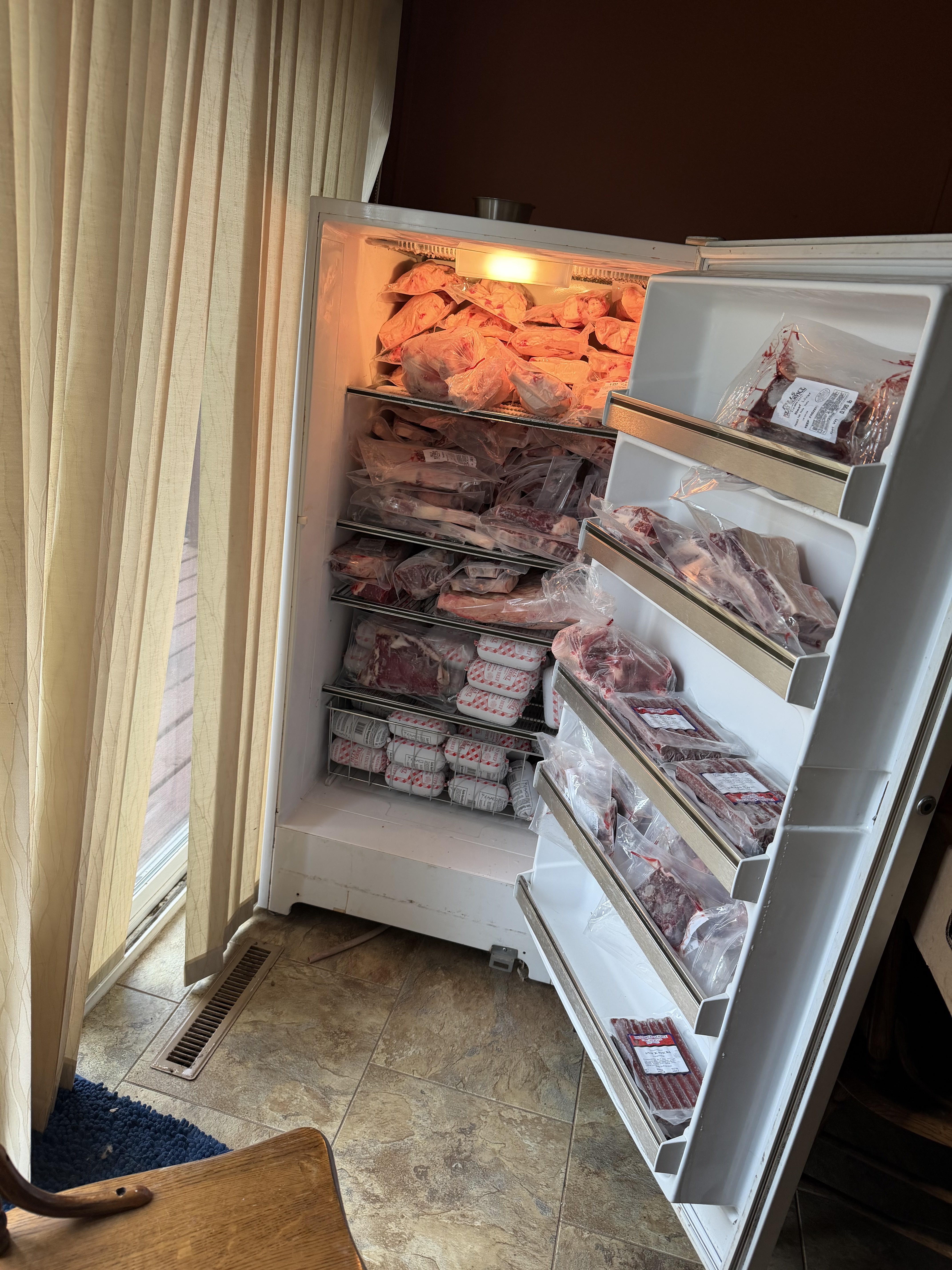
After the bone, fat, and trim loss between hanging weight and freezer, we ended up with somewhere around 415 pounds of packaged beef, organs, and bones — that’s an estimate based on typical processing yield, not a scale total, since neither invoice itemizes a grand total finished weight. Using that estimate, our blended cost comes out to roughly $9.77 a pound — and that single blended number is the whole story.
The Honest Comparison: How Does That Stack Up at the Store?
I took our estimated cut list, priced every single item at current 2026 retail, and totaled it up three ways using USDA and Bureau of Labor Statistics data. I made a point of using everyday shelf prices, not sale prices — because that’s what you’d actually pay. Here’s what the exact same haul would cost today:
| If we’d bought it as… | Total cost | Blended $/lb | How we did vs. it |
|---|---|---|---|
| Commercial (grain-fed) grocery beef | ~$3,846 | $9.26 | We paid ~$208 more (+5%) |
| Grass-fed, direct from a farm | ~$4,654 | $11.20 | We saved ~$600 (−15%) |
| Premium grass-fed (grocery / online) | ~$5,702 | $13.72 | We saved ~$1,648 (−41%) |
| Our actual all-in cost | $4,053.73 | ~$9.77 | — |
Read that top row, because it’s the one that surprised me most. Ordinary grain-fed supermarket beef — the cheapest beef there is — would now cost about $3,846 for the same cuts. We spent $4,053.73. That’s a difference of about $208 across the entire animal, or roughly 5%.
In other words: our grass-finished steer cost us close to what plain commercial grocery beef costs right now — not dead even, but close enough that the gap barely registers next to what we actually got.
That was not true a year or two ago. Back then, conventional supermarket beef was meaningfully cheaper, and whole-animal grass-fed buying was something you did for quality, not price. But beef has climbed so fast — regular ground beef alone is up nearly 13–19% year over year and now averages close to $7 a pound — that the gap has basically closed. The commodity stuff rose up to meet us.
So Is It Worth It?
For us, completely — and now the math agrees, not just the values. Look at what we got for close to the price of grain-fed supermarket beef:
- Within about 5% of commercial grocery beef on price.
- About 15% under what we’d pay buying grass-fed direct from another farm.
- About 41% under premium grass-fed at the grocery store or from an online box service.
We bought up — grass-finished, known-source, full-cut-sheet beef — and paid close to commodity-beef prices to do it. That’s the deal, and in 2026 it’s a genuinely good one.
The Blended-Rate Magic
Here’s the part that finally made it click for me. When you buy a whole animal, every pound costs the same. Our filet mignon cost us about $9.77 a pound. So did our ribeyes. So did our ground beef. So did the soup bones.
At the store, that filet retails for $23 to $30 a pound and those soup bones for $5. But in our freezer, they all came in at the same blended rate — which means the premium cuts are effectively deeply discounted, subsidized by the everyday cuts you were going to buy anyway.
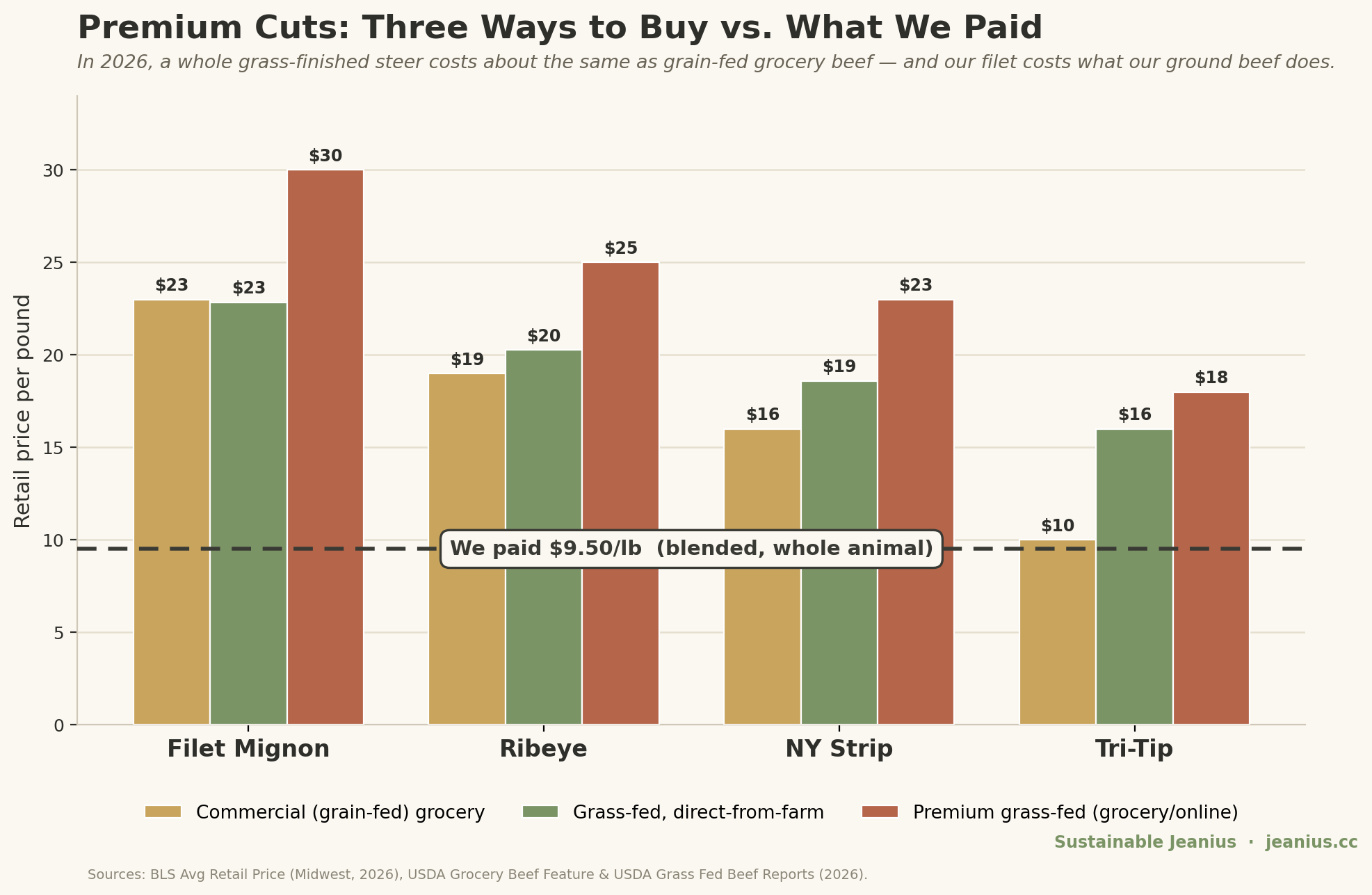
If you tried to buy only the marquee steaks à la carte, you’d burn through the value of the animal in a hurry. The whole point is that you take the brisket and the round roasts and the heart and the oxtail along with the ribeyes — and the math only works because you do.
What You’re Really Buying
So, was it worth it? Completely — and in 2026, you barely pay a premium over commodity beef for it. We did it for the things that don’t always show up cleanly on a spreadsheet:
- A known source. We bought from my cousin. We know exactly how the animal was raised and finished.
- Grass-finished quality at close to commodity-beef cost. Within about 5% of grain-fed supermarket beef, and far under premium grass-fed retail.
- Total control of the cut sheet. Thick steaks, the roasts we actually use, snack sticks for the truck, organs for us and the dogs, bones for broth and tallow. Nothing went to waste.
- A full freezer and a year of not thinking about it. That convenience is worth real money too.
If You’re Thinking About Doing This Yourself
A few honest takeaways before you go halves on a steer with family or a friend:
- Budget for processing as a real line item. Ours ran $1,142.73 — well over a thousand dollars — and it’s easy to forget when you’re focused on the price of the animal.
- Run the comparison at today’s prices. Beef costs have moved fast. The case for whole-animal buying is far stronger in 2026 than it was even a year ago, simply because grocery beef caught up.
- You need the freezer space. Half a steer is a lot of beef — make sure you have somewhere to put 400-ish pounds.
- Two invoices makes multi-household splits easier. If you’re splitting an animal with someone at a different address, ask the butcher to write it up as two separate orders. It made sorting and delivery painless for us.
- Run your own numbers. Prices, yields, and processing rates vary by farm, butcher, and region. Don’t take my $9.77 as gospel — take it as a starting point and build your own sheet. (Ours is based on an estimated yield, not a scale weight of what we actually received — get an actual total if you can, and your per-pound number will be more solid than mine.)
We came out of this with a freezer full of grass-finished beef we feel good about, at close to the price of supermarket commodity beef — and a fraction of what premium grass-fed would have cost. For a working homestead in western Wisconsin, that’s a win we’ll take every year.
Related Posts
- Why We Preserve — the same cost-and-control logic applied to canning and dehydrating
- A Meal Planning System That Actually Prevents Food Waste — building meals around what’s already in the freezer
- Seasonal Eating in Wisconsin — the same “buy in bulk when it’s at its best” logic applied to produce
Prices reflect what we actually paid in June/July 2026 — ours to the farmer and butcher, and retail comparisons priced at the same time. Beef prices are moving fast right now, so if you’re reading this later in the year, check current prices before you budget.